Water pollution has always been a serious issue that produces negative impact on human health and threats the achievement of sustainable development (Halder & Islam, 2015). To some extent, wastewater is a key cause of water pollution. Under this condition, it is necessary to carry out effective wastewater treatment process to improve the quality of water (Anjum, Rasheed, & Ahmed, 2016). Nevertheless, the treatment of wastewater is a quite complex project because wastewater generally contains various constituents such as chemical constituents, physical constituents, and biological constituents (Abdalla & Hammam, 2014). To some extent, the complexity of wastewater constitutes has pose serious challenges to the wastewater treatment. Under this condition, it needs to adopt suitable wastewater treatment solutions to treat wastewater in an effective way.
Clean drinking water is indispensable resource for all life on the earth. However, the development of industrialization has resulted serious water pollution and the shortage of clean drinking water. In this case, how to access the clean drinking water has become a challenge faced by countries across the world. According to the Sustainable Development Goals, clean water and sanitation is one of key sustainable development goals (Weststrate et al., 2019). Although the proportion of global population who access to safely drinking water services increased from 61% in 2000 to 71% in 2105, it needs to be noticed that around 785 million people at global scope still cannot access to the basic drinking water service (United Nations, 2019). Nevertheless, wastewater pollution is increasingly serious worldwide, which pose serious challenges to the achievement of the sustainable development goal in terms of Clean Water and Sanitation (Weststrate et al., 2019). For this, wastewater treatment has become an urgent problem that needs to be addressed well in order to achieve the sustainable development goal on clean water and sanitation.
To date, there are different wastewater treatment approaches that have been used to deal with the increasingly serious wastewater problem. Chemical wastewater treatment has been recommended as one of effective solutions to deal with the problem of wastewater (Sahu & Chaudhari, 2013). Normally, wastewater generally contains various chemical constituents such as perfluorooctanoic acid, acids compounds, dichloroethane, chemical drugs, and chemical dyes and so on. The existence of various toxic chemical materials in wastewater has caused a series of environmental and health issues such as the breed of pathogenic microorganism that are detrimental to human health and the shortage of clean drinking water. In this case, the adoption of chemical wastewater treatment has become one of effective solutions to treat the wastewater problem. According to Asiwal et al. (2016), the principle of chemical wastewater treatment is to use chemical additions to change the quality of water from wastewater to clean water. Through chemical wastewater treatment methods, it can eliminate the chemical constituents present on wastewater for addressing wastewater issue.
The most common chemical wastewater treatment methods mainly include chemical coagulation, pH control, chemical precipitation, adsorption and oxidation (Asiwal et al., 2016). For example, Chemical coagulation is a wastewater treatment process that aims to separate suspended solids portion and precipitate soluble heavy metals from the waster for changing the quality of waster (Sahu & Chaudhari, 2013). Figure 1 shows the Chemical coagulation process of wastewater. The first step is to add chemical additions to wastewater. In the second step, the chemical additions that are added to the wastewater are mixed quickly to make the distribution of the chemical additions throughout the wastewater. In the third step, chemical constituents present on wastewater are flocculated to become insoluble solid, which are further precipitated in the fourth step. In the final step, the coagulated chemical constituents are removed from the wastewater to change the quality of the water.
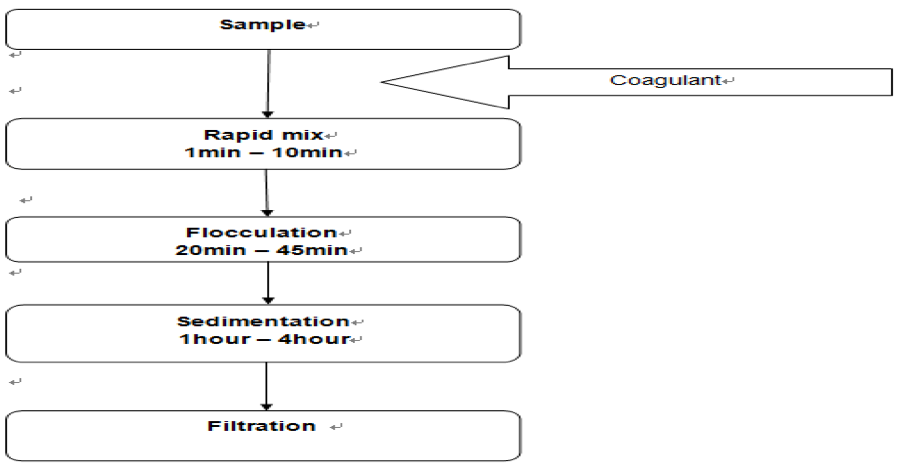
Source from: Sahu & Chaudhari (2013).
Through such chemical wastewater treatment solutions, it can effectively turn the wastewater into clean water. To a large extent, the adoption of chemical wastewater treatment methods to threat wastewater helps to meet the sustainable development goal on water and sanitation. According to the sustainable development goals framework, the sustainable development goal 6 aims to achieve some eight targets (Winkler et al., 2017). The first three targets of the sustainable development goal 6 are relevant to drinking water supply and sanitation. The target 6.1 of the sustainable development goal 6 is to ensure the equitable and universal access to safe and affordable drinking water for all, the target 6.2 of the sustainable development goal 6 is to achieve the access to equitable and adequate sanitation and hygiene for all, and the target 6.3 of the sustainable development goal 6 is to improve the quality of water by reducing pollutants, eliminating hazardous chemicals and materials, and increasing recycling use of safe water (United Nations, 2019). Chemical wastewater treatment solutions are used to remove hazardous chemicals and materials from wastewater. By using chemical wastewater treatment solutions, it would help to eliminate hazardous chemicals and materials in the wastewater and therefore ensure the access of clean and safe drinking water (Winkler et al., 2017). Hence, Chemical wastewater treatment processes are effective treatment solutions to wastewater and helps to achieve the sustainable development goal 6.
References
Abdalla, K. Z., & Hammam, G. (2014). Correlation between Biochemical Oxygen Demand and Chemical Oxygen Demand for Various Wastewater Treatment Plants in Egypt to Obtain the Biodegradability Indices, International Journal of Sciences: Basic and Applied Research, 13(1), pp. 42-48.
Anjum, M. N., Rasheed, H. U., & Ahmed, W. (2016). Impact of Waste Water Treatment on Quality of Influent & Effluent Water,Imperial Journal of Interdisciplinary Research,2(11), pp. 844-849
Asiwal, R. S., Sar, S. K., Singh, S., & Sahu, M. (2016). Wastewater Treatment by Effluent Treatment Plants, SSRG International Journal of Civil Engineering,3(12), pp. 29-35.
Halder, J. N., & Islam, M. N. (2015). Water Pollution and its Impact on the Human Health. Journal of Environment Pollution and Human,2(1), pp. 36-46.
Sahu, O. P., & Chaudhari, P. K. (2013). Review on Chemical treatment of Industrial Waste Water. Journal of Applied Sciences and Environmental Management, 17(2), pp. 241-257.
United Nations (2019). Sustainable Development Goal 6. Available from: https://sustainabledevelopment.un.org/sdg6 [Accessed: 13 August 2019].
Winkler, M. S, Jackson, D, Sutherland, D, Payden, D. S., Lim, J. M. U, Srikantaiah, V, Fuhrimann, S, & Medlicott. K (2017). Sanitation safety planning as a tool for achieving safely managed sanitation systems and safe use of wastewater, WHO South-East Asia Journal of Public Health,6(2), pp. 34-40.
Weststrate, J., DijkstraJasper, G., Eshuis, J., Gianoli, A., & Rusca, M. (2019). The Sustainable Development Goal on Water and Sanitation: Learning from the Millennium Development Goals. Social Indicators Research,143(2), pp. 795-810.
 urban wastewater treatment